


Summary
Today is World Book Day, a celebration of the joy of reading. Jaheda, a healthcare assistant at Martlets, talks about the healing power of books and the importance of reading to patients on the inpatient ward.
Some people with life-limiting illnesses find that reading in the standard way can become more challenging. Their concentration span may decrease, it may become difficult to sit comfortably for any length of time, or to physically hold a book and turn the pages. Listening to audio books or reading on a digital tablet may be helpful, or even having someone read to you. We have iPads on the ward that patients can use to read and to listen to audio books, but patients will often say there’s nothing like being read to by a loved one or one of us on the ward. It can be a source of comfort and connection.

Jaheda (centre) and a Martlets nurse, reading to a patient from an iPad on our ward.
A patient who is Hindu asked if I could read to her from the Bhagavad Gita, the holy book of Hinduism. That’s not my religion, but I was able to read it for her as I speak several languages, even though it wasn’t written in my mother tongue. I didn’t want to offend her by getting the chanting wrong as there is a certain way to say it out loud, but she said it didn’t matter to her that I was from a different faith and couldn’t speak it perfectly; she just wanted to feel the words and the deeper meaning. I have also read from the Bible to patients when they have requested it.
Terminal illness can affect anyone no matter what race, religion or social standing they have. Understanding that we are all spiritually equal means that every person deserves the same care and compassion. I once looked after a patient who was from Israel. Even though she was Jewish and I am Muslim we got on well. She saw me as an individual, a person caring for her, not as someone from an opposing faith. Her husband and I got on brilliantly because we’re both Arsenal supporters!
I think people probably thought ‘uh oh’, as given the tensions in the Middle East you might not have expected us to get along. But we got on so well that she even wanted to gift me her husband’s Arsenal memorabilia books that he’d brought in! It’s a safeguarding policy at Martlets that we don’t accept gifts from patients and families, unless it’s small things like sweets. Her husband was awesome and we read the books together when he visited and had some great football chats.
Books can really bring people together and inspire ideas and spark the imagination. We have plenty of children’s books in our Family Room for visitors to share and a few in our Sanctuary. David, who has done a lot of fundraising for Martlets, happened to read a book in the Sanctuary which was an inspiration and a comfort after his father died.
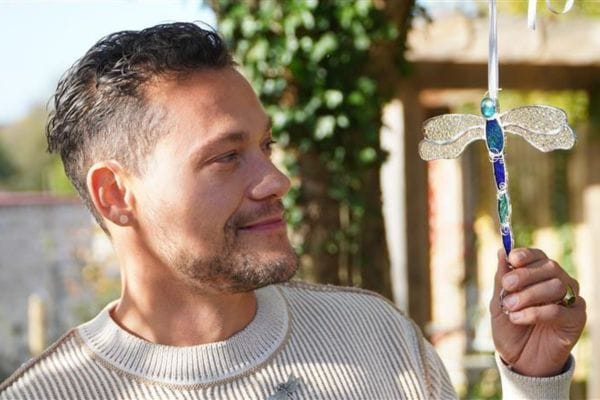
David admiring the stained-glass dragonfly charm that reminds him of his father.
David says:
“We spent time in the Sanctuary at Martlets which was a peaceful space to rest and reflect. There was a book in there called Water bugs and dragonflies which helped us explain the process of dying to the younger children in our family. It was written for children on the theme of transformation, but I loved the symbolism. It had a spiritual tone to it without being religious.
On the morning Dad passed away, something beautiful happened – there were dragonflies in my garden hovering around. I was sitting there trying to process everything and suddenly this dragonfly just appeared. I don’t have any water features in my garden and I know dragonflies are attracted to water, so it seemed odd that it would appear out of nowhere. Every time since then, around that time of year, dragonflies turn up again, which is probably coincidental but it’s a lovely way of remembering him.
We also commissioned a big mural of a dragonfly for the tenth anniversary of Dad’s passing – it’s about halfway up London Road in Brighton near Circus Parade. It was done by a local graffiti artist whose work we liked. I also came into Martlets with my mum and sister and we hung a beautiful stained-glass dragonfly outside in the gardens in memory of Dad. It was made by a staff member’s mum at Martlets.”
Read David’s story in full here.
As it’s World Book Day, why not recommend one of your favourite books to friends and family? And if you’re visiting a loved one on the ward, do pop into our Family Room and have a look through our book shelf.
…………………………
Books that relate to end-of-life and death and dying
We all have favourite authors and books that we return to again and again, whether were fans of fiction, factual, memoir or personal development. At Martlets, we are often asked by patients’ loved ones for suggested books that relate to end-of-life and death and dying. Here are just a few titles that may be of interest on this subject:
- With the end in mind by Kathryn Mannix – Dying, death and wisdom in an age of denial.
- Being Mortal by Atul Gawande – Illness, medicine and what matters in the end.
- Dear Life by Rachel Clarke – A doctor’s story of love, loss and consolation.
- Grief Works by Julia Samuel – Stories of life, death and surviving.
- Always and Forever by Debi Gliori & Alan Durant – a children’s book.
- Water Bugs and Dragonflies: Explaining death to young children by Doris Stickney – a children’s book.
Updated 01/03/26